
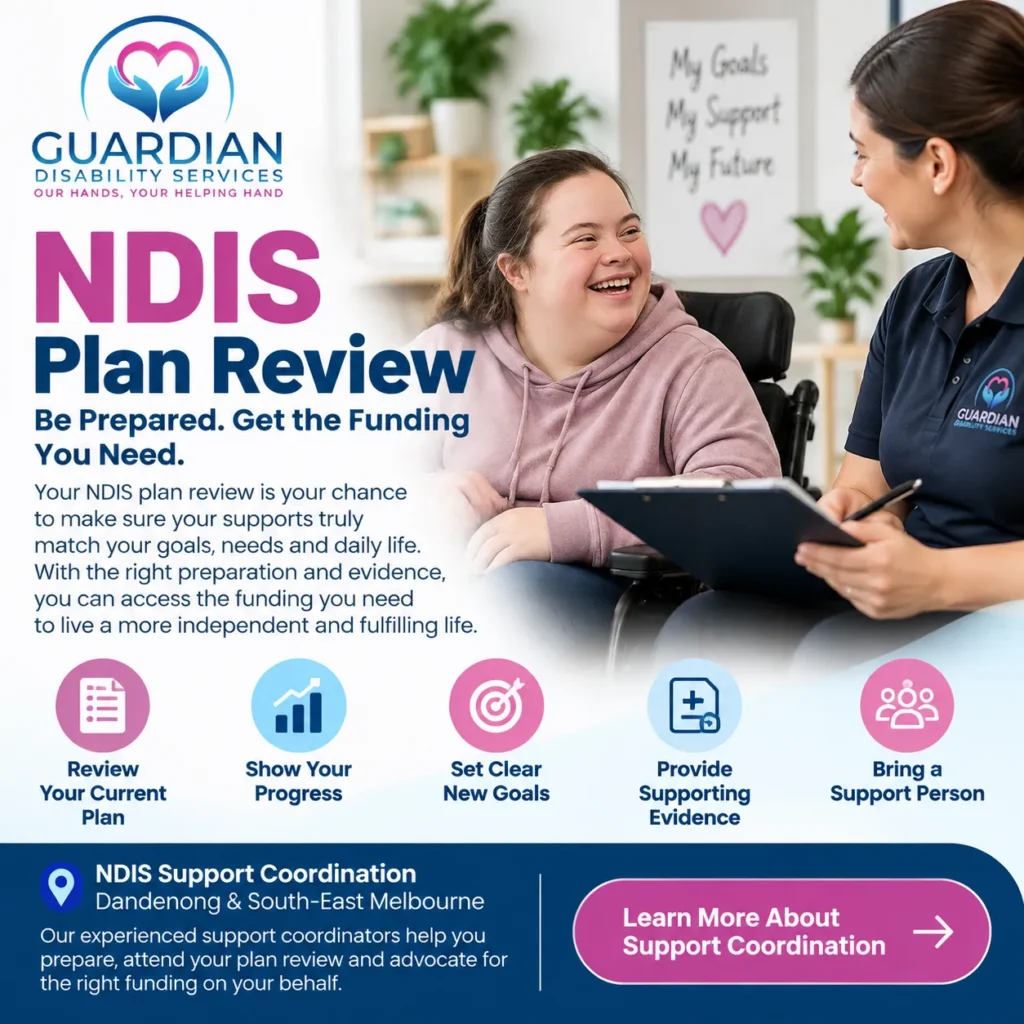
How to Prepare for Your NDIS Plan Review – Step-by-Step Guide
The review of your NDIS plan will be one of the most critical conversations of the year. Do it well, and you will get the funding you require for support. If not done well – by coming without preparation, without being specific, or lacking evidence – and your plan will fail you for another year. The following information provides you with all you need to attend the review well-prepared.
What is an NDIS plan review?
NDIS plan reviews are periodic reviews of the participant’s NDIS plan which normally occur every 12 months. During plan reviews, the participant, his or her support coordinator, and the NDIS planner discuss achievements made towards reaching the goals, changes in needs for supports and how the funding will look in the following plan. A well-planned review leads to more funding, while a badly planned one usually leads to the same or even less funding.
Your Plan Review Checklist – Start Here
Gather them at least 4–6 weeks ahead of your plan review date. Don’t wait until the week just before.
NDIS Plan Review Preparation Checklist
- Current NDIS plan — know your current budget categories, amounts and end date
- Spending summary — how much of each budget has been used and what for
- Goals progress notes — what has been achieved, what hasn’t, and why
- Allied health reports — OT, physio, speech pathology, psychology (within 12 months)
- Medical evidence — GP or specialist letters documenting current functional impact
- Support worker progress notes — documenting daily support needs and tasks provided
- Support coordinator summary — coordinator’s written account of plan implementation
- Carer impact statement — if an informal carer is involved, document their role and capacity
- New goals list — what you want to achieve in the next 12 months, written specifically
- New support requests — any supports not currently in your plan that you are requesting
Step-by-Step – How to Prepare Your Plan Review
1. Review your current plan thoroughly
Open or print your NDIS plan. Highlight all your support budgets – Core, Capacity Building and Capital. Indicate what you have spent and what is yet to be spent as well as why underspending may happen in some cases.
2. Document progress toward current goals
For each goal in your current plan, write 2–3 sentences: what progress has been made, what evidence supports this, and what has prevented further progress. Be specific. “Working toward independence in the kitchen” is less useful than “now able to prepare simple meals with verbal prompting 3 times per week, previously required full physical assistance.
3. Write your new goals – specifically
Funding within NDIS will come through goals. Generalized goals create general plans, which may be underfunded. Write specific goals related to functionality and supports – “Increase community participation through attendance at 2 social activities per week with assistance from support worker.”
4. Gather all supporting evidence
Contact your occupational therapist, physiotherapist, speech pathologist, general practitioner, and specialists a minimum of 6 weeks prior to the review. Ask for up-to-date functional reports that include details on how the disability affects daily activities. Functional evidence, or “what the participant cannot do without assistance,” is the most powerful evidence for funding through NDIS.
5. Ask your support coordinator to prepare a submission
A support coordinator familiar with your case may help in preparing a submission for plan review outlining the progress of goals, current supports, needs in the current plan and funding required for the next plan. Such a submission can be one of the most valuable resources during a plan review.
6. Prepare your support requests – by name
List your required supports by name, “Short Term Accommodation for 14 days per year,” “Supported Independent Living support worker roster,” “Support Coordination at Level 2.” Vague appeals such as “more support” will have a lot less chance of achieving your funding objective than naming your required supports.
7. Bring a support person to the review
Never attend an assessment of the plan without anyone else being there. Take with you a support coordinator, a family member, a disability advocate, or all of them. The NDIS planner is making his assessment of your requirements – and he needs to have someone there who can give him facts.
Need a support coordinator to prepare your plan review?
Guardian’s coordinators in Dandenong and south-east Melbourne prepare plan review submissions, attend review meetings and advocate for appropriate funding on behalf of participants.
Common NDIS Plan Review Mistakes – and How to Avoid Them
1. Going without a coordinator or advocate
Remember that the NDIS planner is not your advocate; he will assess you according to your presentation only. Support coordinator or an advocate would shift the entire power equation in your favor.
2. Not gathering evidence in advance
It is common for allied health reports required a week before the review to be late. You should begin six weeks beforehand.
3. Being vague about support needs
The words “I need more help” will not generate more money. It is the detailed functional description of the work to be done that prompts action from the NDIS planners.
4. Accepting a reduced plan without questioning
If the NDIS proposes funding that does not match your documented needs, you have the right to request a review of that decision. Your support coordinator can help.
5. Underspending and not explaining it
In case there has been underspending from your budget, the NDIS could decrease your budget. Make sure to always provide an explanation regarding underspending such as lack of providers, COVID interruptions, or the health episodes of participants.
6. Forgetting to request new supports by name
If you require community nursing, SIL, or respite be included in your service package – ask for it, with the proof! These services are unlikely to be included without being asked for!
What Happens After the Plan Review?
After your plan review meeting, your new plan will be developed by your NDIS planner. This process usually takes between 2 to 6 weeks. You will be notified once your new plan has been approved and implemented. In case your new plan does not reflect the discussion or has not incorporated any of the support that you had asked for, you can request an internal review of this decision; you can get help in doing so from your support coordinator.
With your new plan in place, your support coordinator will then help you implement the plan.
Guardian Disability Services provides NDIS support coordination across Dandenong, Pakenham, Cranbourne, Berwick and Narre Warren. Our coordinators prepare plan review submissions, attend review meetings and advocate for appropriate NDIS funding on behalf of participants and families across south-east Melbourne.
Frequently Asked Questions – NDIS Plan Review
An NDIS plan review is a scheduled reassessment of a participant’s plan – typically annually. The participant, support coordinator and NDIS planner discuss progress toward goals, changes in needs, and what funding should be in the next plan. A well-prepared review results in better funding outcomes.
Start 4–6 weeks before: review your current plan and spending, document goals progress, gather allied health reports, prepare new goals and support requests, ask your support coordinator to write a submission, and arrange for your coordinator or an advocate to attend with you. Specific evidence and specific requests produce better outcomes than vague descriptions of need.
Evidence includes reports from occupational therapists, speech pathologists, physiotherapists and other allied health providers; letters from GPs or specialists; support worker progress notes; your support coordinator’s written submission; and a carer impact statement if an informal carer is involved. Functional evidence – documenting what the participant cannot do independently – is the most persuasive.
Yes – and they should. A support coordinator who knows your situation can present evidence effectively, answer the planner’s questions, and advocate for specific funding. Guardian’s coordinators across Dandenong and south-east Melbourne routinely attend plan reviews and prepare detailed submissions on behalf of participants.
Common mistakes: attending without a coordinator or advocate; not gathering evidence in advance; being vague about support needs; failing to explain underspending; not requesting specific support types by name; and accepting a reduced plan without questioning. A well-prepared review with a coordinator significantly reduces these risks.
Yes. Request an unscheduled review when circumstances change significantly – a deterioration in condition, change in carer availability, new diagnosis, housing change, or carer in crisis. A support coordinator can help build the case and submit supporting evidence for an urgent review.