NDIS Community Nursing Care Melbourne – What It Is and How to Access It
Community nursing under the NDIS program provides high-quality nursing care at the doorsteps of the participants within Melbourne. The current document explains the various aspects about community nursing, who qualifies to receive community nursing services through the NDIS program, how it differs from regular home nursing services, and how to locate registered service providers in south-east Melbourne.
What is NDIS community nursing care?
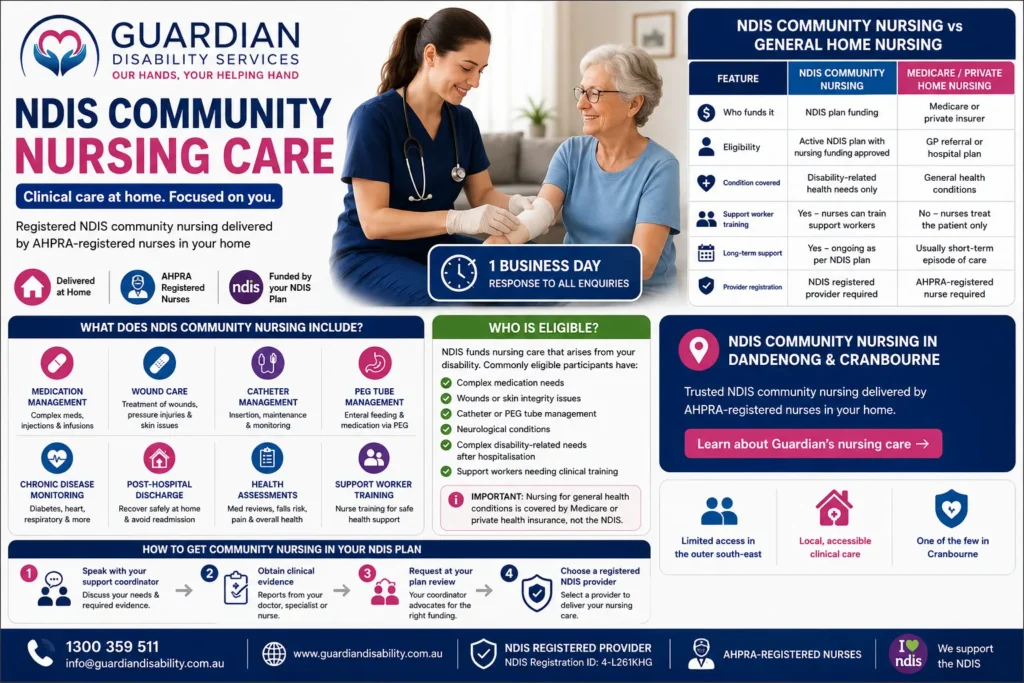
NDIS community nursing care is a registered disability support delivered by AHPRA-registered nurses directly in a participant’s home or community setting. It covers clinical services including medication management, wound care, catheter management, PEG tube care, chronic disease monitoring and post-hospital discharge support. It is funded under the NDIS as a High Intensity Daily Activity support when the nursing need arises from the participant’s disability.
What Does NDIS Community Nursing Care Include?
NDIS community nursing care includes a vast array of clinical nursing services that need to be provided because of the participant’s health needs associated with his/her disability. Such services should be provided either by an AHPRA-registered nurse or under her/his direct supervision.
Medication management
Medication administration and management – This includes drug regimens, injection and infusion therapies that need clinical supervision.
Wound care
Assessment, treatment and monitoring of wounds including surgical wounds, pressure injuries, diabetic foot ulcers and chronic skin integrity issues.
Catheter management
Insertion, maintenance and monitoring of urinary catheters in participants who cannot manage their own catheter care.
PEG tube management
Managing percutaneous endoscopic gastrostomy (PEG) tubes in participants who receive nutrition or medications via enteral feeding.
Managing percutaneous endoscopic gastrostomy (PEG) tubes in participants who receive nutrition or medications via enteral feeding.
Chronic disease monitoring
Monitoring and managing chronic health conditions such as diabetes, heart disease, respiratory conditions and neurological conditions that intersect with the participant’s disability.
Post-hospital discharge
Clinical support following hospital admission — helping participants recover safely at home and reducing the risk of readmission.
Health assessments
Comprehensive nursing assessments covering medication reviews, falls risk, skin integrity, pain management and overall health status documentation.
Support worker training
Education of NDIS support workers to help with certain health activities like medication prompting, bowel management, or personal care procedures under the guidance of nurses.
Who is Eligible for NDIS Community Nursing Care?
Community nursing care under the NDIS scheme is available for individuals whose nursing requirements are because of their disability and not general health issues that are catered for by the Medicare scheme or private health insurance schemes. The NDIS scheme will provide for community nursing care where it is reasonable and necessary.
Participants commonly eligible for community nursing care through the NDIS include those with:
- Complex medication needs requiring clinical oversight or administration
- Wounds or skin integrity conditions linked to their disability or immobility
- Catheter or PEG tube management needs
- Neurological conditions affecting health management capacity
- Complex disability-related health needs following hospitalisation
- Support workers who require clinical training to safely deliver personal care
NDIS vs Medicare nursing
However, nursing services under the NDIS should be linked to an individual’s disability. Therefore, nursing services provided to address health problems that are not disability-related such as after surgery, where the surgical procedure was not related to a person’s disability, should be paid using Medicare. If you are confused about what funding your nursing needs should use, talk to your NDIS support coordinator.
NDIS Community Nursing vs General Home Nursing – Key Differences
| Feature | NDIS Community Nursing | Medicare / Private Home Nursing |
| Who funds it | NDIS plan funding | Medicare or private health insurer |
| Eligibility | Active NDIS plan with nursing funding approved | GP referral or hospital discharge plan |
| Condition covered | Disability-related health needs only | General health conditions |
| Support worker training | Yes – nurses can train support workers | No – nurses treat the patient only |
| Long-term support | Yes – ongoing as per NDIS plan | Usually short-term episode of care |
| Provider registration | NDIS registered provider required | AHPRA-registered nurse required |
NDIS community nursing care in Dandenong & Cranbourne
Guardian Disability Services is registered to provide community nursing support across areas of south-east Melbourne.
How to Get Community Nursing Care in Your NDIS Plan ?
If you need community nursing care but it is not currently funded in your NDIS plan, here is how to request it:
- Step 1 – Speak with your support coordinator. Your NDIS support coordinator can advise whether your nursing needs are likely to be funded by the NDIS and what evidence is required.
- Step 2 – Obtain clinical evidence. A report from your treating doctor, specialist or nurse documenting the nursing needs arising from your disability is typically required. An occupational therapy or nursing assessment can strengthen the application.
- Step 3 – Request at your plan review. Nursing care is requested at your NDIS plan review meeting. Your support coordinator can attend and advocate for the appropriate funding level based on your documented needs.
- Step 4 – Choose a registered NDIS nursing provider. Once approved, select a registered NDIS provider to deliver your community nursing. Guardian Disability Services provides community nursing across south-east Melbourne.
Guardian Disability Services provides NDIS community nursing care across south-east Melbourne including Dandenong, Cranbourne, Pakenham, Berwick and Narre Warren. Guardian’s community nursing model includes clinical support delivered in participants’ homes and community settings, subject to individual clinical requirements and service capacity.
.
Why Community Nursing in Dandenong & Cranbourne is a Critical Service Gap ?
Nursing services registered under the NDIS in south-east Melbourne, especially Dandenong, Cranbourne and the City of Casey, are quite scarce. The major nursing providers of NDIS services operate out of inner Melbourne, thus making nursing services unavailable to those located in the outer south-east region of the city.
The nursing program at Guardian seeks to fill this void. The nurses working with us conduct visits to our clients residing in Greater Dandenong, Cranbourne, Clyde, Pakenham and their surrounding areas, based out of our centre in Dandenong North.
For NDIS participants in Cranbourne specifically, Guardian is one of the only registered NDIS providers with a dedicated community nursing capability in the area – a significant advantage for participants with complex health needs who cannot easily access nursing support elsewhere.
Frequently Asked Questions – NDIS Community Nursing Care
NDIS community nursing care is a registered support delivered by AHPRA-registered nurses in participants’ homes or community settings. It covers clinical services including medication management, wound care, catheter management, PEG tube care, chronic disease monitoring and post-hospital discharge support – all funded through the NDIS when needs arise from a participant’s disability.
Yes. The NDIS funds community nursing care under the High Intensity Daily Activities support category when the nursing need is disability-related, reasonable and necessary, and delivered by or under the supervision of an AHPRA-registered nurse. Nursing care for general health conditions unrelated to the participant’s disability is not covered by the NDIS.
NDIS participants with disability-related clinical nursing needs are eligible. This includes participants with complex medication requirements, wounds or skin integrity issues, catheter or PEG tube management needs, chronic conditions intersecting with their disability, or those requiring clinical support following hospitalization. A support coordinator can help determine eligibility and build an evidence case for nursing funding.
NDIS community nursing is funded by the participant’s NDIS plan and covers disability-related nursing needs only. Medicare home nursing covers general health conditions through a GP referral. Key differences: NDIS nursing can include support worker training; NDIS nursing is ongoing as per the plan; Medicare nursing is typically a short episode of care. Many participants access both — NDIS nursing for disability needs and Medicare for general health conditions.
Yes. Guardian Disability Services provides NDIS community nursing care across Dandenong, Cranbourne, Pakenham, Berwick and Narre Warren. Our AHPRA-registered nurses deliver clinical care directly in participants’ homes.